RACC Blog

Artists Chosen for Mural Project at Arbor Lodge Shelter Lead with a Community-Centric Approach

FOR IMMEDIATE RELEASE

November 14, 2023

Meech Boakye, Communications Lead, RACC, mboakye@racc.org

Sophie May Hook, Public Art Project Manager, RACC, shook@racc.org

Portland, OR – The Regional Arts & Culture Council (RACC), in partnership with Multnomah County, the Joint Office of Homeless Services and Do Good Multnomah, proudly announces the selection of artists Lillyanne Pham (LP/she/they) and Paola De La Cruz (she/her) for the creation of a new exterior mural at the Arbor Lodge Shelter, anticipated to be unveiled in the spring of 2024. The mural will be a visual cornerstone of the shelter’s renovation, aimed at providing a range of support and services to North Portland’s houseless community.

Lillyanne Pham, a second-generation Vietnamese artist and cultural organizer, creates through a systemic consciousness framework, focusing on place-based justice and racial equity. LP’s collaborative partner, Paola De La Cruz, of Dominican heritage, weaves digital and analog media into narratives exploring cultural identity and interpersonal growth. Together, they’ve created a collaborative artistic practice, Qué Lo Gì, known for conceiving socially engaged projects that bridge individual stories with communal experiences which resonate with diverse local communities.

Qué Lo Gì, Website, @que_lo_gi

Lillyanne Pham, Website, @lillyannepham

Paola De La Cruz, Website, @happynappystudio

About the Arbor Lodge Shelter Mural Project 

The artwork is developed in coordination with RACC through the Multnomah County Percent for Art Program. The project seeks to add vibrancy to the shelter’s north and west exterior walls, invoking a powerful visual statement at the busy intersection of N Lombard St and N Denver Ave. The artist team of Qué Lo Gì will create an original artwork in collaboration with the local community, instilling a sense of welcome, belonging and joy for the shelter guests and neighborhood alike.

About the Shelter

The Arbor Lodge Shelter, a former pharmacy purchased using federal COVID-19 funding, was first used in February 2021 as a severe weather shelter before going on to serve as a year-round emergency shelter that combined an indoor sleeping space with sleeping pods in its parking lot. Now, as part of an ongoing shelter expansion by the Joint Office of Homeless Services, funded by the Supportive Housing Services Measure, the Arbor Lodge Shelter is being renovated into a long-term, purpose-built 24/7 shelter through reservation/referral only, focused on serving up to 106 people in the community and North PDX area.

The Joint Office of Homeless Services oversees the delivery of services to people experiencing homelessness in Multnomah County. The office represents a shared commitment between Multnomah County and the City of Portland to address homelessness by providing housing assistance, shelter, outreach, case management and other services.

Community-Centric Approach

The approach to this project is deeply rooted in community engagement and trauma-informed design. Pham and De La Cruz will work closely with shelter guests, local community members, and other key stakeholders to ensure that the mural is informed by their collective voice and the cultural richness of North Portland.

“RACC is thrilled to steward this project in collaboration with our partners at Multnomah County, the Joint Office of Homeless Services and Do Good Multnomah. We recognize the immense value this facility will add to the North Portland area and understand that having meaningful art experiences at the site is instrumental in healing and supporting people through life’s challenges. In addition to making fabulous artworks for the public realm, Lillyanne and Paola bring a depth and care in their creation process that we are grateful to have as part of this project. We look forward to the mural becoming a joyous and impactful sight for all those in the neighborhood” Salvador Mayoral IV, Senior Public Art Manager of the Regional Arts & Culture Council

To learn more about the Arbor Lodge Shelter mural project, the artists, or to schedule an interview with RACC or the project team, please contact Sophie May Hook at shook@racc.org.

About the Regional Arts & Culture Council

The Regional Arts & Culture Council is a 501(c)(3) nonprofit organization that provides impactful and transformative funding for artists and nonprofit organizations in Clackamas, Multnomah, and Washington Counties; manages an acclaimed public art program; leads an advocacy and arts education program; and offers a wide range of technical and professional development workshops. RACC advocates for equity, inclusion, and access, working to build a community in which everyone can participate in culture, creativity, and the arts. We remain steadfast in our mission to enrich every neighborhood we serve.


Portland Ranked 16th Among the 20 Most Arts-Vibrant Large Communities in the Nation

The 8th Annual Arts Vibrancy Index from SMU DataArts Compiles List of 40 Most Vibrant Arts Communities Across the U.S., Based on Measures of Per Capita Supply, Demand and Government Support for the Arts.

SMU DataArts, the National Center for Arts Research, today released its 8th Arts Vibrancy Index, which identifies the Portland-Vancouver-Hillsboro region as number 16 in the list of 20 Large communities in the United States through an analysis of the level of supply, demand, and government support for the arts in more than 900 communities across the country. Organized into three separate lists based on community population size, totaling 40 communities across the country, this year’s Arts Vibrancy Index is the first to include numerical rankings since 2020, a reflection of arts organizations returning to in-person activities and performances following the easing of pandemic restrictions. Portland, along with its neighbors Vancouver and Hillsboro, has consistently appeared on the Arts Vibrancy Index since 2016. This year, the Portland-Vancouver-Hillsboro area is ranked sixteenth on the annual list of the 20 most arts-vibrant large communities in the nation.

Related research by SMU DataArts shows that Local Arts Agencies (LAAs) like the Regional Arts & Culture Council (RACC) are powerful catalysts of arts vibrancy which ensure that the arts remain an integral part of community life. RACC was built by community for community. For almost three decades, RACC has stood by our mission and values: To enrich our communities through arts and culture and create a thriving region, powered by creativity, bringing arts and culture to every neighborhood.

Arts-vibrant communities can be found in every region of the United States—a finding which arises from an objective analysis of the data, and not from selecting communities by hand to achieve geographic representation. “The arts and culture sector was hit hard by the pandemic, and some organizations and communities are still recovering. The Index is an opportunity for communities to affirm and celebrate the individuals and organizations that are the sources of arts vibrancy in their region, whether that’s artists who have mastered a local craft tradition over generations, a cultural festival that families enjoy year after year, or a cherished historic theater, museum, or arts-education center. For organizations, funders, local citizens, and public officials, the Arts Vibrancy Index is a powerful resource that leverages data-driven evidence to illuminate how the arts contribute to an area’s economy and public life,” stated Dr. Zannie Voss, Director of SMU DataArts. “One way that public leaders can spark arts vibrancy in their communities is by expanding funding for local arts agencies, which spurs arts employment, stimulates more artistic activity, and increases the strength of geographically dispersed arts-vibrant cultural resources throughout communities.”

In addition to the top arts-vibrant communities listed in the Arts Vibrancy Index, arts-vibrancy scores for every county in the United States can be viewed on an interactive map that identifies arts and cultural strengths that are present in every community. (Also known as Metropolitan or Micropolitan Statistical Areas, these communities have boundaries that are defined by the United States Census Bureau.)

Large Communities (population: 1 million +)

    1. San Francisco-San Mateo-Redwood City, CA
    2. New York-Jersey City-White Plains, NY-NJ
    3. Washington-Arlington-Alexandria, DC-VA-MD-WV
    4. Boston, MA
    5. Philadelphia, PA
    6. Minneapolis-St. Paul-Bloomington, MN-WI
    7. Frederick-Gaithersburg-Rockville, MD
    8. Nashville-Davidson-Murfreesboro-Franklin, TN
    9. Los Angeles-Long Beach-Glendale, CA
    10. New Orleans-Metairie, LA
    11. Cincinnati, OH-KY-IN
    12. Cleveland-Elyria, OH
    13. Cambridge-Newton-Framingham, MA
    14. Denver-Aurora-Lakewood, CO
    15. Pittsburgh, PA
    16. Portland-Vancouver-Hillsboro, OR-WA
    17. Seattle-Bellevue-Kent, WA
    18. Milwaukee-Waukesha, WI
    19. Chicago-Naperville-Evanston, IL
    20. St. Louis, MO-IL

View additional lists and information here.


Groundbreaking Study Reveals Economic and Social Impact of Nonprofit Arts & Culture

FOR IMMEDIATE RELEASE: OCTOBER 20, 2023

Arts & Economic Prosperity 6 Study Centers Equity in Economic Research and Highlights Vital Role of Arts and Culture in Building More Livable Communities

PORTLAND, OR. – The Regional Arts & Culture Council announced today that Multnomah County nonprofit arts and culture industry generated $400,700,004 in economic activity in 2022 in Multnomah County, according to the newly released Arts & Economic Prosperity 6 (AEP6), an economic and social impact study conducted by Americans for the Arts. That economic activity – $400,700,004 in spending by nonprofit arts and culture organizations and $4,495,889 in event-related spending by their audiences supported 5,841 jobs and generated a total of $72,062,487 in local, state, and federal government revenue in the County. Spending by arts and culture audiences generates valuable commerce to local merchants, a value-add that few other industries can compete with.

Building on its 30-year legacy as the largest and most inclusive study of its kind, AEP6 uses a rigorous methodology to document the economic and social contributions of the nation’s nonprofit arts and culture industry. The study demonstrates locally as well as nationally, arts and culture are a critical economic driver of vibrant communities.

Nationally, the Arts & Economic Prosperity 6 (AEP6) study reveals that America’s nonprofit arts and culture sector is a $151.7 billion industry—one that supports 2.6 million jobs and generates $29.1 billion in government revenue.

“Arts and culture organizations have a powerful ability to attract and hold dollars in the community longer. They employ people locally, purchase goods and services from nearby businesses, and produce the authentic cultural experiences that are magnets for visitors, tourists, and new residents,” said Nolen V. Bivens, president and CEO of Americans for the Arts. “When we invest in nonprofit arts and culture, we strengthen our economy and build more livable communities.”

AEP6 represents a reset from its previous versions, establishing a new benchmark in the AEP study series.

  • Social Impact: For the first time, AEP6 expands beyond the economic and financial data to include social impact measurements of arts and culture’s effect on the well-being of communities and residents.
  • Equity and Inclusion: AEP6 broke new ground by prioritizing equity, community engagement, and inclusivity. With the goal of reducing systemic bias, Americans for the Arts transformed its approach and expanded the inclusion and participation of organizations serving or representing BIPOC- (Black, Indigenous, People of Color) and ALAANA- (African, Latine, Asian, Arab, Native American) identifying communities.

Nationally, the extensive research reveals proportional economic and community impacts among attendees at BIPOC and ALAANA organizations to the overall national average. These findings should initiate new, and escalate existing, critical funding conversations about BIPOC and ALAANA organizations receiving fair and proportional financial support.

Key figures from the City of Portland’s AEP6 study include:

  • The City of Portland nonprofit arts and culture industry generates $4,589,494 in event-related spending by its audiences.
  • The typical attendee spends 36.45 per person per event, not including the cost of admission.
  • 32.1% of arts and culture attendees were from outside the county in which the activity took place. They spent an average of $55.21. All vital income for local merchants.
  • 87.2% of respondents agreed that the activity or venue they were attending was “a source of neighborhood pride for the community.”
  • 87.9% said they would “feel a sense of loss if that activity or venue was no longer available.”

By measuring arts and culture’s wide-ranging impact, public and private sector leaders can work together to secure funding and arts-friendly policies that shape more vibrant and equitable communities. The full report, a map of the 373 study regions, and a two-page economic impact summary for each, can be found at AEP6.AmericansForTheArts.org.

Read more and access study findings here. Join us on Monday, November 6th from 5:30 to 7:30 pm PST at Lakewood Center for the Arts, Lake Oswego for a a comprehensive exploration of Tri-County reports in collaboration with Oregon Arts CommissionTualatin Valley Creates, and Clackamas County Art Alliance.

Virtual Engagement

Event Livestreamed on Zoom from 6-7 pm Register now!


Media Contact: Mario Mesquita, mmequita@racc.org

About the Regional Arts & Culture Council

An independent nonprofit organization, we support greater Portland’s creative economy by providing equitable funding and services to artists and art organizations; managing and growing our diverse, nationally acclaimed public art program; and developing long-lasting public and private partnerships.

For more information visit racc.org.

About the Arts & Economic Prosperity 6 Study

The Arts & Economic Prosperity 6 study was conducted by Americans for the Arts, the nation’s leading nonprofit organization for advancing the arts and arts education. It was supported by The Ruth Lilly Endowment Fund of Americans for the Arts. Americans for the Arts’ 297 study partners contributed both time and financial support to the study.

For a full list of the communities who participated in the Arts & Economic Prosperity 6 study, visit AEP6.AmericansForTheArts.org.


The Arts Propel Communities Forward

Laura Streib, AEP6 Coordinator

For the last year, RACC and Americans for the Arts have been connecting communities through arts and culture events throughout Multnomah County and the City of Portland.

By attending a myriad of events and connecting with attendees, as well as nonprofit organizations, we have been able to get a clear picture of what the arts landscape provides in terms of an economic recovery as we continue to emerge from the COVID-19 shutdowns.

One thing we found crystal clear from all the events we were able to attend is just how grateful people are to get out and be part of cultural events again. The need to be able to connect with others is deep and profound.

The results of the surveys provide incredible insight into how the arts and culture nonprofit sector specifically has been resilient in working hard to bring us together and continue to make Portland and Multnomah County the creative and unique place it has always been. A quick overview –

By the Numbers

  • 12,280 jobs and $6 million dollars in household income from working in the arts/nonprofit sector
  • $19.9 Million in local tax revenue generated
  • $25.5 Million in State tax revenue generated
  • $114.6 Million in Federal Tax revenue generated

The ripple effects out into the greater economy can be seen and felt in event-related spending that totaled $331.2 million dollars. When people go out to experience a play or concert or gather for a cultural experience – everyone benefits.

For example, the coffee shop or restaurant where someone stops before or after a show, the drinks enjoyed in the lobby, or the childcare spent to enjoy a night without the kids. All this adds up.

At one event we attended at the Old Church Concert Hall, we had a fascinating conversation with two friends who had driven down from Seattle to attend the sold-out concert. When they started filling out the survey, they realized all of the extra costs associated with what they thought was just a concert.

They paid for gas on their drive down to Portland, they stayed overnight in a local Airbnb, and they went out for dinner, drinks, and coffee. One individual bought a T-shirt from the concert and a vinyl record. Throughout our conversation, it became clear that the arts are an important driving force in our economy.

We know the world has changed dramatically since the last AEP study was released. The data from that last study has helped individual artists apply for grants, assisted organizations in strategic planning, and even shaped planning and policy in Troutdale. Those effects continue to resound today. Data from the AEP5 study was used by the Economic Development Coordinator in Troutdale to push their city leaders to extend the Troutdale Arts Festival into a weekend-long event that closed the main street in old town Troutdale. Having the data of the arts driving economy was the push the city decision-makers needed to implement this new festival which now draws thousands of people each summer. This has led to more concerts in the park, movie nights, and other cultural events throughout the summer in East Multnomah County.

Arts and Culture are major drivers of our economy and are something our city officials and elected leaders need to be mindful of as we continue to emerge from these continued uncertain times. As Oregon is ranked 41st in terms of public dollars invested in Arts and Culture, we need to do more to leverage the creative economy for the betterment of our communities.

The arts mean business in the Greater Portland area. 


Save the Date!

The Regional Arts & Culture Council (RACC), in collaboration with Oregon Arts Commission, Tualatin Valley Creates, and Clackamas County Art Alliance, is excited to unveil the recently released Arts & Economic Prosperity 6 (AEP6) study, a comprehensive exploration from Americans for the Arts into how arts breathe life and dollars into our economy.

Join us on Monday, November 6th, 5:30 – 7:30 pm PST at Lakewood Center for the Arts, Lake Oswego (Map). Secure Your Spot!


Arts for All Program Increases Access and Outreach in Community

The Regional Arts & Culture Council Announces a Relaunch of the Arts for All Program to Increase Engagement and Outreach in Our Community, and Beyond, Ensuring Arts & Culture Are Accessible for All

We envision a community that supports, engages with, and finds joy in arts and culture being accessible by all–not just those who can afford to pay, but also for those with limited resources. RACC wants opportunities to be available for all members of our community. We want people to be uplifted, enjoy arts and cultural events, and be part of the creative fabric of our state. The Arts for All program was conceived by a group of thoughtful arts leaders more than 10 years ago to ensure that everyone receiving assistance through the Oregon Trail Card/SNAP could attend arts and cultural events for $5 a ticket.

While the Arts for All program has flourished and steadily grown, we have seen that there is a need to increase its accessibility. To achieve our goals, we are relaunching the program with renewed engagement and outreach. Our goals include making the information downloadable from our website at www.racc.org and distributing printed materials throughout the region to hundreds of non-profit social service agencies, county and city government offices, schools, health departments and clinics, community centers, arts and culture organizations, and more. Program information will be available in six languages and will be at culturally specific locations.

Friends of Chamber Music was proud to be one of the founding member organizations of Arts for All back in 2011, and I’ve personally had the privilege of continuing to help coordinate the program for the last several years. It’s been so gratifying to see the impact Arts for All has had in making the arts accessible to all parts of our community and see it become a model for similar programs across the country.  – Pat Zagelow, Friends of Chamber Music Executive Director

The Arts for All program enables us to enjoy arts and culture together while ensuring access for all. Without the support and dedication of arts organizations in our community, this program would not be possible. We are thrilled to announce a new partnership with the Hult Center for Performing Arts in Eugene, Oregon. The expansion of the Arts for All program throughout the state ensures better access to arts and culture for all of our residents.

RACC looks forward to hearing the community’s response for this renewed launch and engagement opportunity for Arts for All. Please let us know how we can continue to ensure that access to arts and culture activities is available for all who wish to participate. Let us know how we can make this community-centered program better! – Carol Tatch, Executive Director, Regional Arts & Culture Council

The organizations who have joined RACC to ensure access to arts and culture in our community are listed at racc.org/artsforall. Please support these arts and cultural organizations any way that you can to show your support for arts and culture access for all. For more information, please email us at arts4all@racc.org.


Advocacy in Arts Education

What do we want? Arts Education! When do we want it? Now!

This seems like the mantra every new school year, every budget season, and perennially from youth across our communities. They love art. They love the paint, the sticky glue on their fingers, the seasonal pumpkin sketches, and the field trips to performances and exhibitions. They love using scissors and cutting hearts out of red construction paper, school assemblies, showcasing their ceramics and photography in the halls, learning current media techniques, and most of all, they love the joy of being creative together.

Advocating for arts and culture in our community and schools is a full-time job. We hope that one day it will just be the norm. People will simply understand the value of arts and culture in our community, in our schools. We will not have to advocate for funding and sustaining a vibrant arts education program in our PK-12 schools, but will be thinking instead about all the new courses, and the arts educators we need to hire because the demand for art is so vast and the classes are too full. Imagine.

Yet, arts and culture are in demand now. Arts save lives. We know that because teachers, community members, students, policy makers, data reports and analysis, and arts organizations remind us repeatedly. It is through arts in our schools that an atmosphere of communication and tolerance, a mapping of emotions through creation, enable students to connect to the greater world. There they can express their creative selves, find their voice, and to see the connectedness of the human spirit. In community, we do the same.

Can you recall the world without music, movies, gatherings and performances while we were in lockdown during the global Covid-19 pandemic? The arts enable us to survive through some of our darkest times as a community, and the arts continue to uplift and support us as we struggle not just to survive, but to thrive in our new world.

We ask you to join us as an advocate for arts education in our schools and in our community. Lend your voice to the chorus, and share your experiences and joy with others. Tell your story of how the arts saved you. Nurtured you. Tell your family members to support candidates and board members that want sustained funding in arts education in our community. Support arts councils that advocate for arts and culture in your community. Support arts organizations by volunteering, attending performances, and sponsoring school trips through donations. Whatever you do, be that advocate and voice for arts and culture in our community and schools. Be loud.

Please join us at www.racc.org/arts-education to learn more.  Tag us on Instagram when you share your stories.

-Chanda Evans, Arts Education Manager


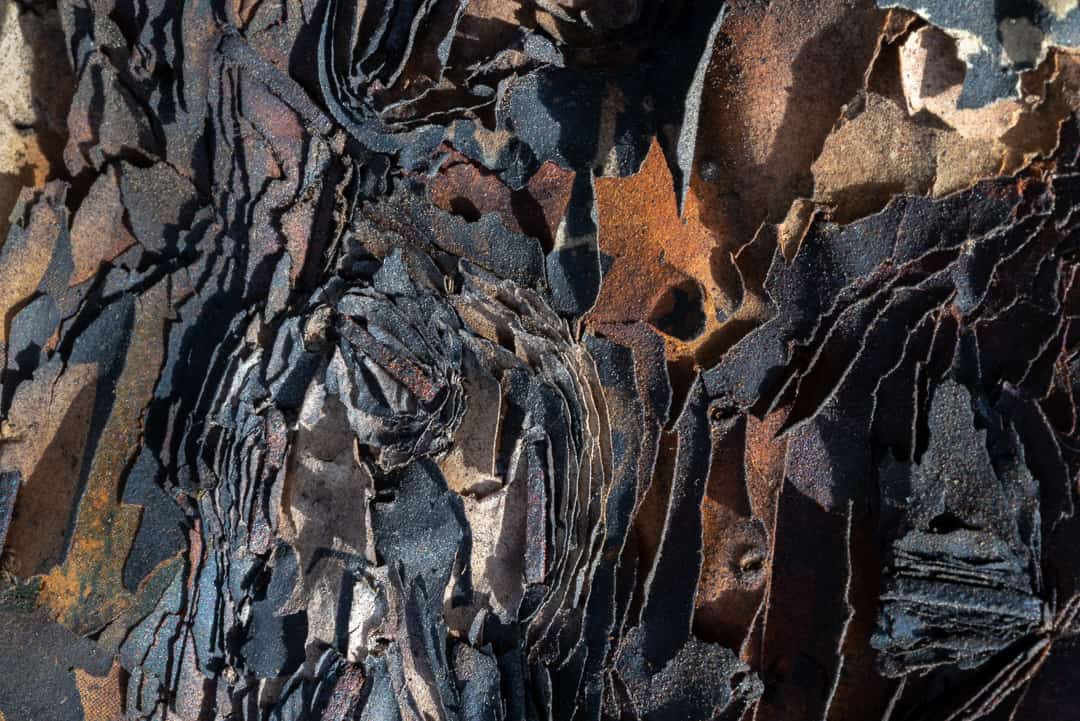
RACC Grantee Heléna Dupre Thompson’s “Unintentional Spectacles”

Laura Vincent Design & Gallery is a space in downtown Portland known since 2018 for its careful selection of contemporary artists. We visited to interview artist Heléna Dupre Thompson and view her exhibition Unintentional Spectacles, funded in part by a Make|Learn|Build grant from the Regional Arts and Culture Council (RACC). 

Thompson was raised in the industrial city of Providence, Rhode Island, and worked as a firefighter. This exhibition served as a testament to her background. Thompson extracts stories from what many overlook: utility poles covered in posters, skate parks, and the undersides of skateboards, transforming close-up images into abstract worlds. 

On view alongside Unintentional Spectacles was James Florschutz’s exhibition, Assembled Fragments. Constructed out of found materials, these objects carried their own histories, challenging our views on urban sprawl and consumerism. Together, these two artists’ were in conversation, their works resonating with each other, weaving narratives of urban life and transformation from the seemingly mundane.

The phrase “industrial beauty” seems like an oxymoron, but in Thompson’s hands, it becomes an exploration of the aesthetic potential hidden in the mundane. “I’ve always been drawn to abstraction,” she says. Providence is a city with an industrial history like her current home, Portland. Despite the geographical distance and the years away, she found unexpected similarities between the two cities. “Providence is kind of like a really small version of Portland,” she notes, describing the shared landscapes, content, and political undercurrents, though also acknowledging a few east-west coast differences.

Her work, characterized by magnifying her lens deep into her subjects, is layered with history, the passage of time, and the gentle or not-so-gentle interventions by humans and nature alike. Focusing on the elements that resonate most with her, Thompson encapsulates vast landscapes within tiny surface areas. “Most of my [photographs]…are about a one to two-inch surface area,” she shares; yet these miniature compositions hint at large geological formations. 

Thompson challenges the notion that her work is a form of documentation. While she captures the tangible realities of her subjects, she intends to remove them from their context and allow them to stand separate. It’s an intriguing juxtaposition of preservation and abstraction that pulls viewers into an almost ethereal space, urging them to question and rethink what they’re perceiving. “I do this…for the viewer to see it however they want to see it,” she explained. The result is an abstraction so detailed, it becomes a world unto itself.

Thompson embraces spontaneity in her creative process, and her work emerges from the unexpected, while staying grounded in the physical world. “Most of my work happens on-site,” Thompson reveals. But there is an element of serendipity at play. She explains, “Sometimes I’ll be riding my bike and I’ll find chunks of metal or glass [on the roadside]. I’ll [then] take them back to my studio and compose them there.”

“Being in that environment, hearing the sounds, seeing the people, meeting the people, smelling the smells… It makes me more connected to the city and the people.”

Her experimentation is not confined to stationary objects; she draws inspiration even from the fleeting, like skateboarders gliding by at the park. “I’m interested in the surfaces that the skaters skate on, but also what the undersides of their boards look like,” she says, unveiling an exciting recent find, recycled skateboard decks. “This is the thing that scraped the wall that I was photographing and now…already…this is a piece,” she marvels, cradling the board. “I love [this] kind of layering…First of all, there’s a graphic on it, right? And then somebody bought it and put these stickers on it. And then who knows where this board has been? Now, through the actions of the skater, it becomes a mashing and regeneration of the original colors, lines and textures,” she contemplates, her words subtly drawing parallels between her work and life itself – a multitude of intricate, layered experiences.

Thompson sees the relationship with these environments and communities as a two-way street — she was observing them, and they were inadvertently shaping her. 

“Being in that environment, hearing the sounds, seeing the people, meeting the people, smelling the smells… It makes me more connected to the city and the people. Even if I see them once, there’s a bond that I feel more connected to,” she confessed. “Being amongst artists and communities, I’ve gotten so much out of that and learned so much from it.” These interactions fostered a sense of shared understanding, a silent bond that she found incredibly nurturing. “I feel like it makes me a more present person, more caring. As artists, we have this connection that a lot of people don’t have. It’s made me feel more whole in a lot of ways, more connected to my environment and myself.”

Thompson also noted the crucial role of funding bodies like RACC, acknowledging how its support had impacted her journey as an artist. She concluded, “[This grant] allowed me to take a few leaps forward, to prioritize my craft, to grow, and to learn. I truly believe I wouldn’t have been in this gallery now if it weren’t for the timing of that grant.” 

As we wrapped up, I was given the exciting news that Thompson had been asked to be represented by Laura Vincent Gallery as the show concluded, confirming the steady evolution of her artistic trajectory. Laura Vincent Gallery’s invitation emphasizes Thompson’s unique visual language and the raw intimacy she brings to her work. With her journey marked by a non-traditional, self-guided education, Thompson’s story reflects the potential for diverse routes into the art world, celebrating creativity that thrives outside established norms. 

All images by Heléna Dupre Thompson, from Unintentional Spectacles.” 


RACC Grantee North Pole Studio Recount their Experience at the Outsider Art Fair

In the spring of 2020, North Pole Studio emerged as a testament to creative inclusion and artistic empowerment. In June of 2023, I spoke with Sula Willson about the organization and their recent experience at the Outsider Art Fair in New York City, a trip made possible through a Regional Arts & Culture Council Arts3C grant. Co-founded by a dedicated group of artists, educators, and advocates — Sula Willson, Mary Ellen Andersen, Davis Wohlford, Sarah Mensah — the organization serves as a robust platform supporting careers in the arts, particularly for artists with autism and intellectual/developmental disabilities. As Willson shared in our conversation, “…we decided to open North Pole Studio as another option for folks who needed a creative space that was intentionally smaller, intentionally quieter, and highly individualized.” 
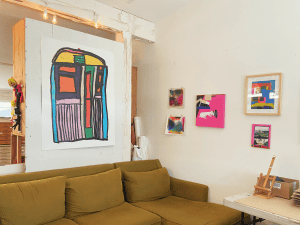
A large, colorful artwork filled with bold lines and abstract shapes sits on a wall. Below it, a comfy looking couch. On the adjacent wall sit five smaller artworks of varying size.

Housed in NW Marine Artworks, Portland’s largest collaborative of professional artist studios, North Pole Studio is more than a 1,200 sq/ft space for creation: it embodies the belief that understanding diverse human experiences is foundational to a vibrant and whole community. With an unwavering commitment to fostering self-determination and facilitating meaningful connections, the organization ensures that its artists thrive as visible contributors to both local and national contemporary art communities. “We always say that the space belongs to the artists… and we are here to facilitate whatever artists come to create and pursue,” says Willson, encapsulating the mission of North Pole Studio and its focused approach. 
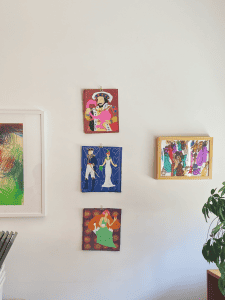
In a vertical line, three small paintings on cardboard sit on a wall. Each depict colorful, costumed, faceless figures. To the right and left are more gestural and abstract framed works. A potted plant peeks into the left side of the image.

Communication is central at North Pole Studio, bridging gaps and enabling artists to navigate opportunities and employment within the art world and beyond. Willson explains, “…we scaffold communication in a lot of different ways, but we use a lot of social stories, visual supports,” tailoring contracts or other documents that may be inaccessible to individual artists. Collaboratively, unique strategies are crafted for each artist. For some artists like James Enos, the studio acts as the primary liaison with his book dealer. For others, like Austin Brague, guidance is provided as he applies for opportunities independently.  The need for spaces like this studio is great, as evidenced by North Pole Studio’s rapid growth. As the organization begins to tackle questions of growth and scalability, one thing is clear: at North Pole Studio, the individual needs of the artists will always take center stage. 

As with many arts nonprofits, the challenging landscape of funding underscores their mission. In an endeavor to make their workshops more accessible, the studio has introduced a sliding scale fee for all programs, which in turn amplifies the need for more robust external funding. Despite this terrain, the determination of Willson, Andersen, and the myriad collaborators that allow the space to run smoothly, remains unwavering. What keeps them going is their recognition of the transformative influence that this support and advocacy has on artists’ lives. Willson describes, “having someone recognize that you are capable of something bigger than you thought… is empowering within itself.” 


In our conversation, Willson highlighted North Pole Studio’s core belief of fostering individual growth and opening doors to opportunities for artists with autism and intellectual/developmental disabilities. Their commitment to this mission was brought to life when they attended the Outsider Art Fair in New York City, made possible through funding from RACC. This experience served as both an enriching platform for their artists and a milestone in the studio’s journey. Now, to truly capture the experience, let’s turn to the team at North Pole Studio, who share below their firsthand reflections and insights from the fair: 


In March 2022, RAAC awarded an Arts3C grant that made it possible for North Pole Studio to represent three artists at the highly competitive Outsider Art Fair in New York City. This eye-opening and career-changing exhibition opportunity would not have been possible without RACC’s funding, and we are deeply grateful for the support. The fair was a true whirlwind — an enriching, educational, challenging, colorful experience that provided a valuable new perspective for our staff, artists, and their advocates, family members, and community members.

The Outsider Art Fair is the largest exhibition of self-taught artists in the world. It occurs biannually in Paris and New York, and is internationally attended by exhibitors, visitors, and patrons alike. “Outsider Art” or art brut (raw art) historically describes artists who are creating outside of educational institutions and traditional techniques, or those without exposure to (whether intentional or not) or influence from popular art culture and trends. Aesthetically and philosophically, this work has a rawness to it — and is valued for its pure, expressive, seemingly unselfconscious quality which captures the artists’ completely original experience.A scanned piece of paper filled with pink and red handwriting.

Some of the most renowned “Outsider” artists include Bill Traylor, who was born into slavery and began creating art in his eighties; Martín Ramírez, a railway worker who was institutionalized with schizophrenia in his later life; and Judith Scott, a deaf woman with Down’s Syndrome who discovered her creative voice in a supported art studio. In the contemporary art world, the “Outsider Art” movement has broadened significantly, encompassing a diverse community of artists both dead and living. Today, the commonality among artists represented at the fair is that they are entirely self-taught, and are creating extraordinary artwork in a style and technique that is completely their own. 

As the field has evolved, the term “Outsider” itself has become controversial. Many of the artists represented at the fair are from marginalized communities, including artists that are low-income, disabled, and BIPOC with many intersections in between. North Pole Studio is intentionally embedded inside the professional arts community. Our location is a strategic choice to combat the isolation and access barriers that artists with disabilities continue to face in their communities. While almost all of the artists we serve are entirely self-taught, the desire to identify as an “Outsider” in the art world varies from artist-to-artist and is rejected by many.

North Pole Studio is part of a nationwide movement of progressive art studios who are working to amplify the voices and work of artists with disabilities. The energy of this movement is vibrant, and very much alive at the fair. Using these funds from RACC, we were so proud to represent artists Austin Brague, Dan Tran, and James Enos. Our highlight by far was having Austin and Dan join us in New York City to represent their work firsthand. Austin worked on his submission for over a year — a large scale pen and ink drawing of New York City — which he triumphantly sold at the fair, breaking many New Yorker hearts. Artist James Enos is co-represented by Booklyn, Inc. and this was his second appearance at the fair. He also sold an original work on the first day. James’ work truly stands out at the fair, as he is among a minority of artists working in book form and has developed an unparalleled binding technique, which includes large-scale illustrations which can fold out over 5 feet long. Dan Tran is a rising star in the progressive art world, and it was our pleasure to make face-to-face introductions to fans from all over the country who continue to follow his work.

Austin shared that he had no idea that he was part of such a vast community of self-taught and disabled artists. He was “blown away by the creativity, how vast the collection of work is…[he] had no idea.” Selling work at this level made him realize that success as a professional artist is in reach, and it has motivated him to focus his art practice and dream bigger moving forward. Prior to joining North Pole Studio, many of the artists we serve were creating work in isolation, with little access to resources and exposure. Beyond the art sales and professional connections, the community aspect was perhaps the most powerful impact of our experience at the Outsider Art Fair — the sense of place and connection with an international community of self-taught artists who are valued as professionals, and core contributors to art history and contemporary art. 

We learned so much, and returned to Portland with valuable insights to share with North Pole Studio’s community, and Portland’s art community at large. We can’t wait to go back!


To learn more about North Pole Studio, please visit their website. They are currently seeking new artists to join their Main Studio Program this year. If you or someone you know is seeking supported studio space and looking to connect with a community of artists, they’d love to hear from you!

Image Captions, from top to bottom: A glimpse inside of North Pole Studio’s cozy, art-filled space. Detail of various artworks hung on the studio wall. Work by James Enos, Writing